What Goes Into a Brand Book, and Why a Young Label Needs One

Ask a young fashion founder where their brand book is, and you will often get a folder of logos and a colour code on a sticky note. That is a start. It is not a brand book.
Here is how the gap shows up. In one month you brief a freelance designer, a photographer and a creator. Each one does a good job. Put their work side by side, and it looks like three different brands. Nobody did anything wrong. Nobody was told what “right” looks like.
A brand book fixes that. This guide explains what it is, what goes into it, and how a young label can build a useful first version in a week.
What a brand book actually is
A brand book is a short working manual that tells anyone who touches your brand how it looks, sounds and behaves. Think of it as the answer to the question “what would we do here?”, written down so the answer does not live only in the founder’s head.
It is not a legal document, and it is not a design showpiece. For a young label, ten to twenty clear pages is plenty.
Why a young label needs one now
It is tempting to wait until the business is bigger. That is usually when it costs the most to fix. Here is what a brand book does for you early:
- Keeps you consistent. Your website, packaging, Instagram and marketplace listings start to feel like one brand, not four.
- Makes hand-offs easy. Freelancers, photographers, manufacturers and retail partners can start work without a long briefing call.
- Saves money. Fewer rounds of “not quite what we meant” means fewer paid revisions.
- Speeds up decisions. When a new idea comes up, you can test it against the book instead of arguing from taste.
- Builds trust. A buyer, a partner or an investor who sees a clear brand book sees a founder who thinks beyond the first collection.
It also helps when you work with creators. A one-page version of your brand book tells them what to say and what to avoid, which makes micro-influencer collaborations far smoother.
A sample contents page
Here is a contents page you can copy. Each section can be one page or less to begin with.
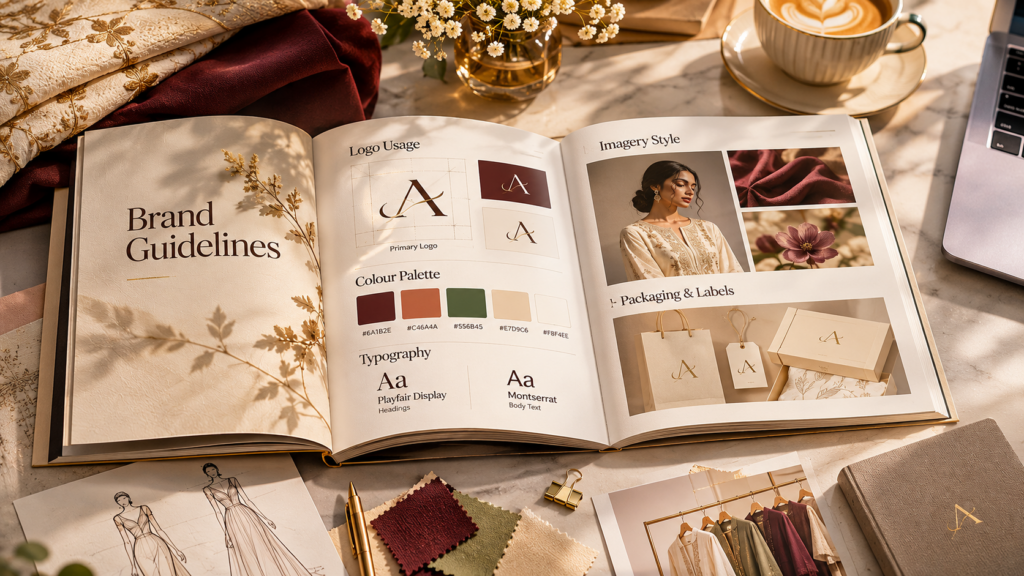
- Brand story and purpose. Why the label exists and what it stands for, in a short paragraph.
- Who it is for. A sketch of your ideal customer: age range, lifestyle, where she or he shops, what they care about.
- Personality and values. Three words that describe the brand, with one line on what each means in practice.
- Voice and tone. How you talk to customers, with a few “we say this, we never say that” examples.
- Logo. The approved versions, the clear space around it, the smallest size it can be used at, and what not to do with it.
- Colour palette. Main and supporting colours with exact codes for screen and print.
- Typography. Which typefaces to use for headings and body text, and where.
- Imagery and photography. The look of your photos: lighting, backgrounds, styling, model direction and editing style.
- Packaging and labels. Hangtags, care labels, mailers and boxes, and how the logo and colours appear on each.
- Everyday applications. Templates for social posts, product pages, emails and WhatsApp messages.
What to leave out for now
A first brand book does not need to be exhaustive. Leave out long histories, rules for sub-brands you have not launched, and anything you cannot decide yet. A short book that people read beats a long one that sits in a drive.
Call it version 1, put the date on it, and plan to review it every six months or after a major change, such as a new product line or a new sales channel.
Mistakes to avoid
- Using words without examples. “Premium, modern, elegant” means something different to every reader. Show a photo, a sample caption or a colour next to each word.
- Copying another brand’s look. It may feel safe, but it leaves you with nothing to call your own.
- Making it beautiful but unusable. If a designer cannot find the colour codes or the logo files, the book has failed.
- Writing it once and forgetting it. A brand book that never changes stops matching the brand.
- Keeping it to yourself. If your team, vendors and creators never see it, it cannot do its job.
A quick illustration
Picture a founder of a womenswear label who briefs a designer for the website, a photographer for the lookbook and a creator for a launch reel, all in the same month. Without a brand book, the website is soft and minimal, the photos are bold and saturated, and the reel is playful and loud. Customers land on the website after the reel and feel they have come to the wrong place.
She spends a week writing a ten-page brand book. Next time, she hands the same book to everyone. The colours match, the photos share a style, and the captions sound like one person wrote them. Nothing about her product changed. Her brand simply started to look like itself. (This is an illustrative example, not a real case.)
A one-week plan for version 1
- Day 1: write your brand story and a short sketch of your ideal customer.
- Day 2: choose your three personality words and write your voice examples.
- Day 3: finalise logo versions and your colour palette with codes.
- Day 4: pick typefaces and collect ten reference images for your photo style.
- Day 5: set out packaging, label and template guidelines.
- Day 6: put it all together in a simple document or slide deck.
- Day 7: test it. Hand it to someone outside your team and ask them to make one social post. If it comes out on brand, you are ready.
Final thoughts
A brand book will not make a weak product strong, but it will stop a strong product from looking scattered. It also reflects how you sell: a brand that knows what it stands for does not have to push, a point we make in our piece on the selling concept versus the marketing concept.
At Dariaan, we help early-stage fashion, retail and lifestyle founders build brands that are ready to launch. Our 120 Days Launchpad includes a brand book as part of full brand building, alongside pricing analysis and launch-ready range planning. If you would like a hand shaping yours, request a call back and we will talk it through.