How Many Styles Should a New Label Launch With?
You have forty sketches, a mood board you love, and one question that keeps you up at night: how many styles should the first collection have?
Launch with too few, and the website looks thin. Launch with too many, and your cash is locked in stock that may never sell. Most first-time founders lean towards too many, because every design feels like a child you cannot leave behind.
There is no magic number. But there is a way to work out yours. This guide gives you a simple framework, a worked example and a checklist to lock your first range with confidence.
The number that matters is not “styles”
Styles are the tip of the iceberg. Each style turns into colours, and each colour into sizes. The real number you are managing is your SKU count, which is the number of different items you must stock.
Take ten styles in three colours and five sizes. That is 10 × 3 × 5 = 150 SKUs. Each one needs stock, a photo, a product page and a place in your packing process. Suddenly “just ten styles” is a lot of work and a lot of cash.
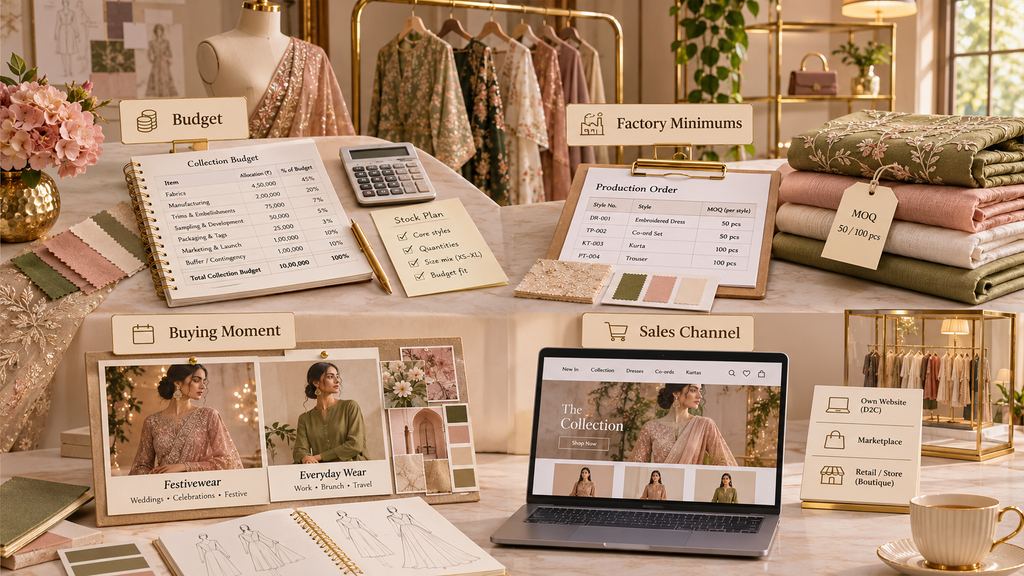
Four things that decide your number
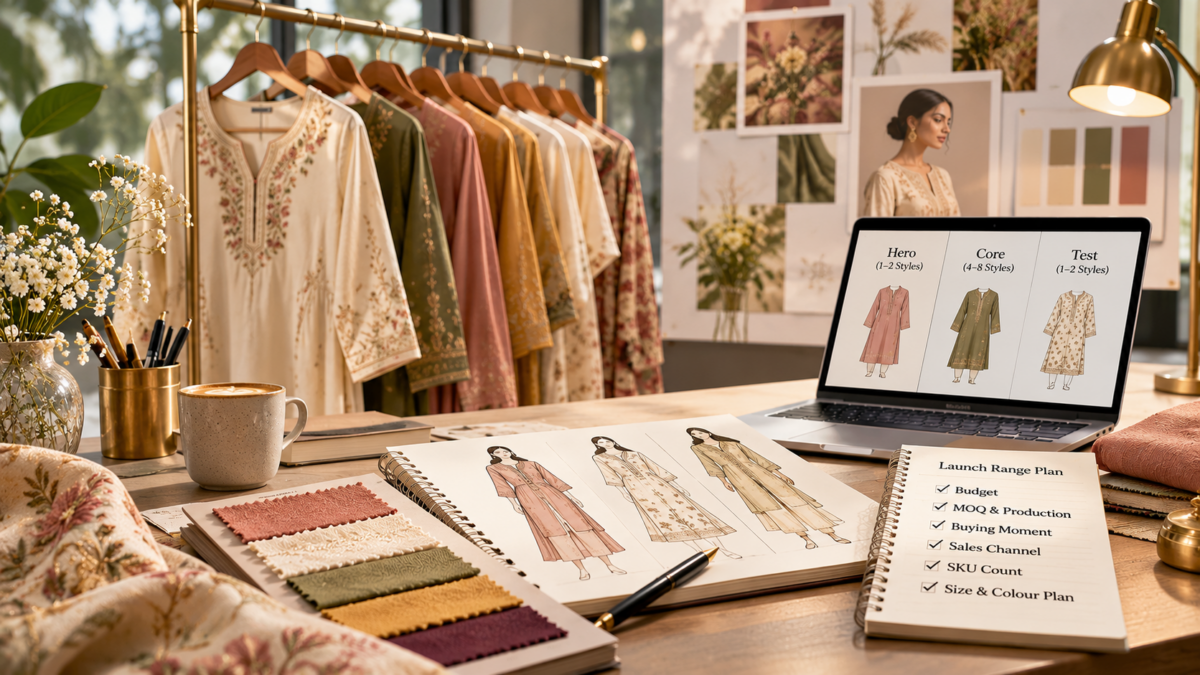
- Your cash. Plan the budget for stock, not just samples. Whatever you spend on stock cannot be spent on photography, packaging and marketing. (Our guide to how much capital an apparel startup really needs helps with that bigger picture.)
- Your factory’s minimums. Most manufacturers set a minimum order per style or per colour. If the minimum is high, fewer styles in deeper stock may work better than many styles in thin stock.
- Your customer’s buying moment. A label built for one occasion, such as festive wear, needs fewer styles than one that dresses someone for every day of the week.
- Your sales channel. A website can show eight styles well. A marketplace shopper expects more choice. A store rack needs enough pieces to look full. Choose your first channel before you choose your range.
A simple structure: hero, core and test
Instead of treating every style as equal, sort your range into three groups:
- Hero styles (one or two). The pieces that carry your brand. They appear in your photos, your ads and your homepage.
- Core styles (the largest group). Easy sellers that fit your customer’s everyday needs and give the range its backbone.
- Test styles (one or two). Bolder ideas made in small quantities. They tell you where to go next without risking much cash.
For many small labels, a first drop of around 6 to 12 styles is a workable starting point. Treat that as a guide, not a rule. Your four factors above decide where in that range, or outside it, you should land.
A worked example
Here is how this might look for a label making cotton kurta sets. The numbers are made up to show the method, so swap in your own.
The founder sets aside ₹6 lakh for the first stock. She plans eight styles and splits them like this:
| Group | Styles | Colours each | Pieces per colour | Total pieces |
| Hero | 2 | 2 | 40 | 160 |
| Core | 4 | 1 | 50 | 200 |
| Test | 2 | 1 | 20 | 40 |
| Total | 8 | 400 |
If the average cost is ₹1,200 a piece, the stock comes to ₹4.8 lakh. That leaves ₹1.2 lakh for the shoot, packaging and launch marketing, which is the part many founders forget to budget.
Notice one more thing. Forty pieces of one style and colour, spread over five sizes, is about eight pieces per size. Add more colours or styles, and each size gets thinner. That is why a bigger range does not always sell more. It often just means more sold-out sizes.
Mistakes to avoid
- Launching everything you designed. Choose the strongest, not all of them. The rest can wait for the second drop.
- Adding colours before you know what sells. One strong colour in more sizes usually beats three colours in thin stock.
- Forgetting size depth. Most customers buy the middle sizes. Skewing stock towards them is safer than splitting evenly.
- Skipping the basics. A range of only statement pieces gives customers nothing easy to say yes to.
- Having no plan for drop two. A launch is the start of a calendar, not a one-off event.
Launch small, then learn
The smartest first range is one you can afford to be wrong about. Launch, watch which styles sell through over the first four to six weeks, then reorder the winners and add your next drop. This keeps your cash moving and your customers coming back for something new. When you are ready to widen the line later, our piece on when and how D2C fashion brands should diversify picks up where this one stops.
A checklist before you lock the range
- Have you set a stock budget and kept money aside for shoot, packaging and marketing?
- Do you know your factory’s minimum order per style and colour?
- Does the range fit one clear customer and one clear buying moment?
- Have you picked your first sales channel?
- Is there at least one hero, a solid core and a small test group?
- Have you worked out the SKU count and the stock per size?
- Is there a rough plan for drop two?
Final thoughts
Range planning is a business decision wearing a creative costume. The founders who get it right start with their cash and their customer, and let the sketches follow.
At Dariaan, we help early-stage fashion, retail and lifestyle founders plan launch-ready ranges as part of our 120 Days Launchpad, alongside brand building and pricing. If you would like a second opinion on your first collection, request a call back and we will go through it with you.